


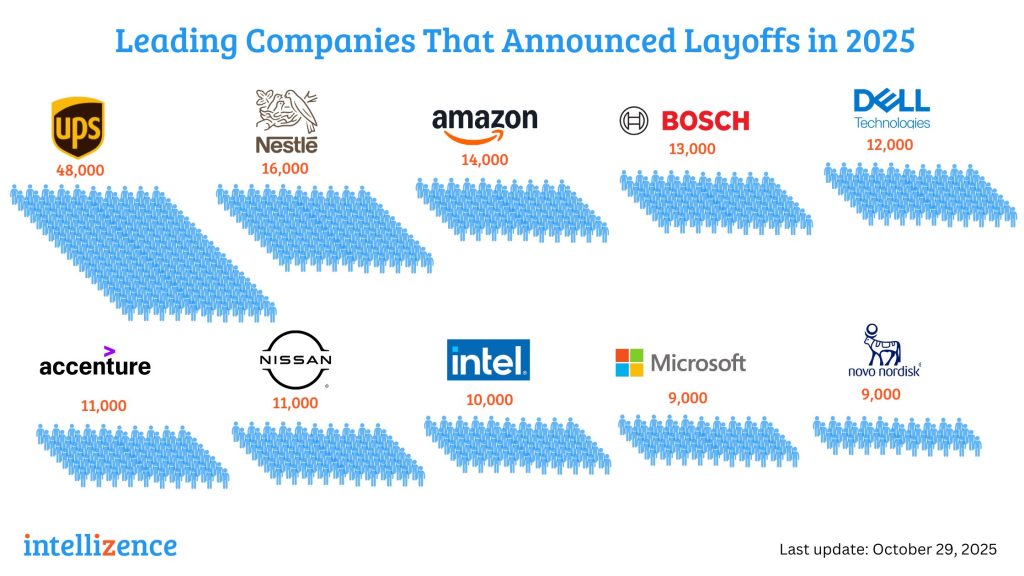
Layoffs are never just about individual companies they are signals. When job cuts rise across industries, they offer an early look into where the economy is heading, how businesses are adjusting, and what skills and strategies will matter next.
Today’s wave of layoffs is not simply a short-term reaction to market pressure. It reflects structural shifts in how companies grow, hire, and operate. Understanding these signals can help leaders, professionals, and investors prepare for what comes next.
This article breaks down the key trends behind today’s layoffs, the warnings they reveal about tomorrow’s economy, and the opportunities emerging beneath the headlines.
Why Layoffs Are Increasing Across Industries
Recent layoffs are occurring even among profitable and well-known companies. This surprises many observers but it highlights a deeper shift in business priorities.
Several forces are driving this trend:
- Higher interest rates increasing the cost of capital
- Pressure to improve profitability and cash flow
- Overhiring during periods of rapid growth
- Automation and AI replacing or reshaping roles
- Shareholder demand for efficiency over expansion
Rather than signaling collapse, many layoffs reflect strategic recalibration.
Trend 1: Profitability Is Replacing Growth as the Top Priority
For years, companies were rewarded for aggressive hiring and rapid expansion. That era is fading.
What Layoffs Reveal
Businesses are now:
- Cutting roles that don’t directly drive revenue or efficiency
- Flattening management layers
- Reducing experimental or non-core initiatives
- Refocusing on sustainable margins
This shift suggests that tomorrow’s economy will favor leaner, more disciplined organizations over those chasing scale at any cost.
Trend 2: White-Collar and Knowledge Roles Are No Longer Immune
Historically, layoffs hit manufacturing and hourly work first. Today, many cuts are happening in:
- Technology
- Marketing
- Operations
- Middle management
- Corporate support functions
What This Signals About the Future
Automation, AI tools, and process optimization are reducing the need for certain knowledge roles. Jobs that are repetitive, poorly defined, or disconnected from outcomes are increasingly vulnerable.
Tomorrow’s economy will reward impact-driven, skill-based roles, not job titles alone.
Trend 3: Skills Matter More Than Employers
Layoffs are accelerating a shift already underway: people are no longer defined by where they work, but by what they can do.
How the Workforce Is Changing
Professionals are increasingly:
- Building portable, in-demand skill sets
- Switching industries more frequently
- Pursuing contract, consulting, or project-based work
- Investing in continuous learning and reskilling
The economy of the future will be more flexible, less linear, and more skills-focused.
Warning Signs Businesses and Workers Should Not Ignore
While layoffs can be strategic, they also highlight risks ahead.
Warning for Businesses
Companies that rely on:
- Cheap capital
- Overstaffed teams
- Vague roles and unclear accountability
- Slow decision-making
May struggle in the next economic phase. Efficiency and adaptability are becoming survival traits.
Warning for Workers
Roles at risk tend to share common traits:
- Limited decision-making authority
- Repetitive tasks
- Poor alignment with measurable outcomes
- Low adaptability to new tools and processes
Ignoring these signals can lead to career instability.
Opportunities Hidden Inside the Layoff Cycle
Despite the disruption, layoffs also create opportunity often for those paying attention.
Opportunity 1: Stronger Talent Availability
Companies that are still hiring now have access to:
- Highly skilled professionals
- Experienced leaders
- Talent previously priced out of reach
This creates a chance to build high-quality teams with greater efficiency.
Opportunity 2: New Business Formation
Economic slowdowns historically produce some of the strongest companies.
Laid-off professionals are:
- Launching consultancies and service businesses
- Building niche products and platforms
- Filling gaps left by downsizing corporations
Entrepreneurship often accelerates during periods of labor disruption.
Opportunity 3: Reskilling and Career Reinvention
For individuals, layoffs can act as a forced but valuable reset.
High-growth skill areas include:
- Data and analytics
- AI and automation tools
- Cybersecurity and risk management
- Operations and process optimization
- Leadership and change management
Those who pivot early often emerge stronger and more resilient.
What Tomorrow’s Economy Is Likely to Look Like
Based on current layoff trends, the future economy will likely be:
- Leaner and more productivity-focused
- Less dependent on large, hierarchical organizations
- More project-based and skills-driven
- Powered by technology and automation
- Focused on measurable outcomes, not headcount
Stability will come not from job security but from skill relevance.
How to Prepare for What Comes Next
For Businesses
- Invest in productivity, not headcount
- Build adaptable teams with broad skill coverage
- Tie roles clearly to outcomes and value creation
- Prepare leaders to manage through change
For Professionals
- Focus on transferable, future-proof skills
- Learn to work with data and AI tools
- Develop leadership and decision-making ability
- Stay flexible across roles and industries
Preparation not prediction is the best response to uncertainty.
Final Thoughts: Layoffs Are Signals, Not the End
Today’s layoffs are not just bad news they are economic signals.
They warn of a shift away from excess and inefficiency. They highlight vulnerabilities in outdated roles and business models. And they create opportunities for those willing to adapt, learn, and move early.
Tomorrow’s economy will reward resilience, relevance, and results.
Those who read the signals now will be best positioned to thrive when the next growth cycle begins.